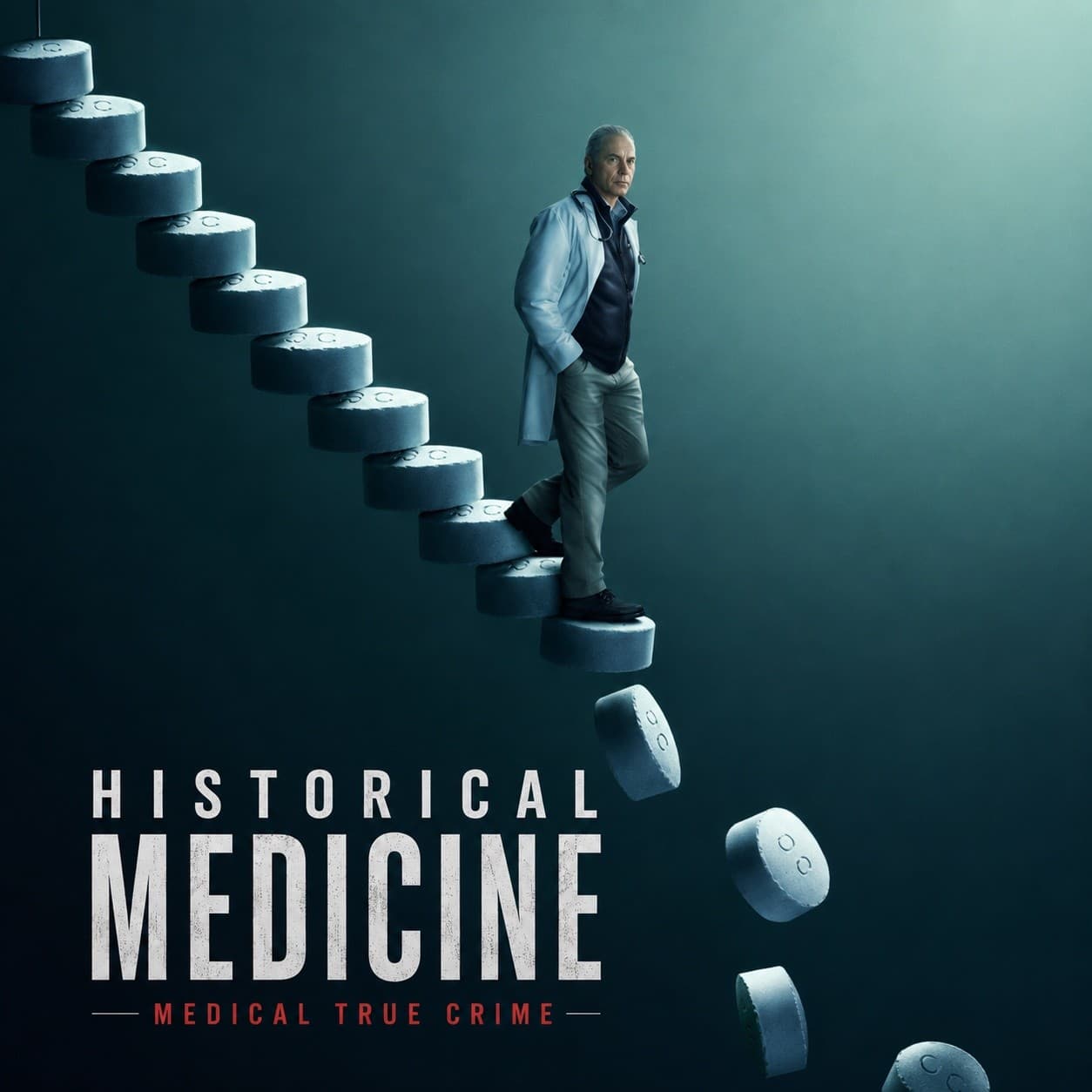
Historical Medicine
88 épisodes
Historical medicine is a record of brilliant guesses, catastrophic certainties, and cures that killed. Doctors bled presidents to death with total confidence, and laughed at the first man who told them to wash their hands. This show tells the true stories of historical medicine. You will walk hospital wards where historical medicine did more harm than the illness, follow surgeons racing the clock before anesthesia existed, and meet the stubborn few whose heresies became the foundations of modern care. Some episodes follow a single outbreak from first fever to final count; others trace a treatment's journey from miracle to malpractice. All of them treat historical medicine as what it really is: the story of humanity learning, painfully, how bodies actually work. If you are drawn to historical medicine told like a slow-burning thriller, this is built for you. New episodes drop regularly, each one a self-contained case from the archives of historical medicine. Subscribe now so the next one lands the moment it goes live.
Également disponible sur


Tous les épisodes
Historical Medicine · 88 épisodes
The private secretary's message that redirected seventy doses
Ep. 88 · 2026-10-22 · 13 min
A radio confession: a prominent journalist says a private secretary redirected seventy Sputnik V doses into the Ministry of Health - who ordered it? The private secretary's message that redirected seventy doses In this episode, we follow how a single phone call and a message moved scarce vaccine doses inside Argentina's Ministry of Health during February 2021. The episode lays out the people, the protocol, and the immediate fallout that raised the question: who was making the calls? Date: February 19, 2021 Person: Horacio Verbitsky Person: Ginés González García Vaccine: Sputnik V Event: Seventy off-protocol doses administered - A radio broadcast in the morning of February 19, 2021, in which Horacio Verbitsky recounts calling the Health Minister and receiving a vaccination at the Ministry after a message from the minister’s private secretary. - Argentina had a written prioritization protocol in February 2021: health workers first, then people over sixty, then high-risk patients, while vaccine supply of Sputnik V arrived in limited batches. - Earlier anomalies included a report of 400 doses disappearing and later surfacing at Olavarría Oncology Hospital, and Beatriz Sarlo saying she had been offered an off-protocol dose. - The incoming minister confirmed that seventy doses had been administered outside the written protocol inside the Ministry of Health building. - Within hours of the radio confession, the count of at least seventy names linked to off-protocol vaccinations became public and triggered criminal and political reactions.
The preserved cast that turned Sarah Baartman into "science"
Ep. 87 · 2026-10-21 · 13 min
A Hottentot Venus displayed in a London cage: how did 19th-century medical "science" turn Black bodies into specimens? The preserved cast that turned Sarah Baartman into "science" In this episode, we trace a chain of documented events linking Sarah Baartman’s postmortem display to surgical experiments on enslaved women and to mid-20th-century medical practices. We follow the people, procedures, and published arguments that normalized using Black bodies for display and experiment, and ask how those methods persisted into modern medicine. Person: Henrietta Lacks Person: Sarah Baartman Person: Anarcha; Lucy; Betsey Event: Postmortem dissection and casting of Baartman by Georges Cuvier Event: Repeated gynecological operations by J. Marion Sims without anesthesia
The consent form she signed in labor that hid the sterilization's permanence
Ep. 86 · 2026-10-20 · 14 min
A sedated woman in labor at USC-LA County Hospital is told her "tubes can be untied later"; she signs a consent form-how did that expose them? The consent form she signed in labor that hid the sterilization's permanence In this episode, we trace what happened in a Los Angeles delivery room in October 1973 and how that moment connects to decades of laws, institutions, and medical practices. The episode follows the records, testimonies, and legal filings to ask how consent was obtained and contested. Person: Jovita Rivera Date: October 12, 1973 Location: USC-LA County Hospital Topic: Sterilization consent and permanency Period: 1969-1973 - A doctor told Jovita Rivera, sedated and in labor, her tubes "could be untied later" and presented a consent form she signed. - Guadalupe Acosta was sterilized at the same hospital in 1973 with doctors claiming her husband consented, which he later denied. - Maria Figueroa lost the ability to bear children, attempted suicide, and her husband barred her from testifying in court. - California’s sterilization law, on the books since 1909, helped normalize procedures that targeted marginalized groups over decades. - Researcher Novak’s analysis of over 17,000 records shows Latinas faced a 59% greater risk of sterilization, with 88% of Spanish-surnamed Californians on forms being of Mexican origin.
The Serbsky Certificate That Silenced a Forester and Stopped His Case
Ep. 85 · 2026-10-19 · 20 min
A forester is certified fit to own a gun one week and declared schizophrenic the next - how did a Serbsky psychiatric certificate silence him? The Serbsky Certificate That Silenced a Forester and Stopped His Case In this episode, we follow the documented pattern of forensic psychiatric evaluations in Russia and how they were used as legal instruments. We outline the institutional history, key cases from 2003-2024, and the procedures that let a diagnosis substitute for a courtroom - why did the system produce such contradictory verdicts? Person: Svyatoslav Barykin Institution: Serbsky Center for Social and Forensic Psychiatry Period: 2003-2024 Practice: Forensic psychiatric evaluations used in criminal procedure - One week apart: a clean mental-health certificate for gun ownership, then multiple psychiatrists diagnose paranoid schizophrenia and dangerous litigiousness. - Serbsky’s forensic mandate gave its written evaluations near-conclusive authority in courts, limiting defendants’ ability to contest findings. - Arrests commonly occurred at night or dawn with direct transport to psychiatric facilities and no formal criminal charge or public record. - Regional rates of schizophrenia findings varied enormously (under 2% to 80%), suggesting diagnostic outcomes functioned like a policy variable. - The Serbsky Center maintained continuity with Soviet-era practices and rehabilitated figures tied to earlier political psychiatry, shaping post-Soviet forensic methods.
The DX‑IIA machine ran thirty‑minute shocks and erased children
Ep. 84 · 2026-10-18 · 15 min
A banned DX‑IIA electroshock machine ran thirty‑minute sessions on children in a Linyi hospital - how did that expose them? The DX‑IIA machine ran thirty‑minute shocks and erased children In this episode, we lay out who, where and how the DX‑IIA device was used inside Room Thirteen at the Fourth Hospital of Linyi and why parents sent kids there. We trace the program’s fees, awards, enforcement methods, and the practices that governed daily life - and ask how those facts led to scrutiny. Person: Yang Yongxin Location: Fourth Hospital of Linyi, Room Thirteen, Linyi, Shandong Province Device: DX-IIA electroconvulsive therapy machine Date: Manufacture halted in 2000; treatment program established 2006 Fee: 5,500 yuan per month - Yang ran a dedicated Internet-addiction treatment center inside the hospital with a monthly fee of 5,500 yuan. - The DX-IIA device, banned from manufacture after 2000 with warnings about cognitive harm, was used in Room Thirteen. - Patients included teenagers as young as twelve; some were brought without consent and families sometimes drugged children before arrival. - Inside the program, youths surrendered online passwords, lived under military-style rules, and were punished for seeking early removal. - Reports say electroshock was applied without anesthesia or muscle relaxants and sometimes continued for up to thirty minutes.
The Repeated Assay That Turned Two Positives into Twenty
Ep. 83 · 2026-10-17 · 16 min
A graduate student in a Reno lab reruns a diagnostic assay until two positives become twenty - how did that repeated assay expose them? The Repeated Assay That Turned Two Positives into Twenty In this episode, we present the sequence of events behind a controversial 2009 Science paper and the lab work, people, and decisions that propelled it into the spotlight. What choices and pressures turned two initial positives into a dataset of twenty, and how did that shape patients’ hopes? Person: Judy Mikovits Location: Reno Date: 2009-10-08 Topic: XMRV and ME/CFS Institution: Whittemore Peterson Institute - A graduate student ran twenty patient samples through a standard assay late at night in 2008 and initially found two positives. - Instead of stopping, lab conditions were adjusted repeatedly until all twenty samples matched the positive result. - Judy Mikovits returned to research as research director at the privately funded Whittemore Peterson Institute after years outside federal labs. - Collaboration began in 2007 between Mikovits and Robert Silverman, who had co-discovered XMRV in prostate cancer tissue. - The October 8, 2009 Science paper reported XMRV in 67% of ME/CFS patients and became a focal point for patients and the scientific community.
The ash on the sheets that proved burn pits poisoned troops
Ep. 82 · 2026-10-16 · 15 min
A contractor woke to ash on his sheets at Joint Base Balad - how did that ash expose burn pits as a public‑health crisis? The ash on the sheets that proved burn pits poisoned troops In this episode, we follow on‑base testimony, official data, and veterans’ reports to lay out what burned at Balad and across the region, and why service members say the smoke followed them home. What evidence ties the ash on beds to long‑term illness? Person: Leon Russell Keith Location: Joint Base Balad, Iraq Event: Ten‑acre burn pit burning 147 tons of waste daily Date: Congressional testimony in 2009; Helping Vets Act signed September 21, 2018 Topic: Documented combustion products including benzene and dioxins - A military contractor described ash on beds, clothes, and sheets and said the thick black smoke did not stay outside. - Balad’s pit burned an estimated 147 tons of mixed waste every 24 hours, fed by JP‑8 jet fuel. - JP‑8 contains benzene (a known carcinogen); low‑temperature plastic combustion can produce dioxins linked to Agent Orange. - The Air Force recorded particulate levels; a 2011 Institute of Medicine review called evidence “limited” but suggestive of pulmonary disease. - By 2014, the National Burn Pit Registry showed high rates of COPD, hypertension, neurological issues, and adverse birth outcomes among enrollees.
The Six Tender Points That Confirmed His Diagnosis
Ep. 81 · 2026-10-15 · 16 min
A physician at a major research university claimed he could reproduce tender points in chronic pain patients-how did that expose them? The Six Tender Points That Confirmed His Diagnosis In this episode, we follow the clinical framework John E. Sarno built around Tension Myositis Syndrome and the patients who crowded his waiting room. We describe his diagnostic signs, his required testing, and the therapeutic approach that relied on explanation and activity rather than surgery-what did those six points reveal about the limits of structural medicine? Person: John E. Sarno Diagnosis: Tension Myositis Syndrome (TMS) Date: 2004 (interview publication) Setting: major American research university practice Key finding: reproducible tenderness at six specific body points in most patients - He reported that 99.999% of his colleagues did not accept his diagnosis, and he declared that figure publicly in a medical interview. - His exam reproduced tenderness at six points: two upper trapezius, two lumbar paraspinals, and two lateral upper buttocks across disparate patients. - Before diagnosing TMS he required imaging and tests to rule out tumors, fractures, and infections, distinguishing his work from dismissive care. - His treatment centered on explaining the diagnosis, expressive writing, return to normal activity, and sometimes support groups or psychotherapy rather than surgery or drugs. - He argued unconscious rage caused autonomic vasoconstriction, producing micro-ischemia and real pain despite the origin being emotional.
The Sodium Fluoride Poured into Grand Rapids That Made 300,000 Subjects
Ep. 80 · 2026-10-14 · 16 min
A worker poured sodium fluoride into Grand Rapids' water on Jan 25, 1945, making residents unwitting subjects - how did that expose them? The Sodium Fluoride Poured into Grand Rapids That Made 300,000 Subjects In this episode, we follow the sequence of discoveries and decisions that led a city to add sodium fluoride to its water without consent and launch a long-running public-health experiment. The narrative traces the scientists, the data, and the choices that turned a cosmetic dental mystery into national policy - what questions did those early steps leave unanswered? Person: Frederick McKay Person: H. V. Churchill Person: H. Trendley Dean Date: January 25, 1945 Location: Grand Rapids, Michigan - A 27-year-old dentist in Colorado Springs cataloged widespread “Colorado brown stain” on children’s teeth and noted unusually low cavity rates. - A chemist for Alcoa analyzed water samples in 1931, finding elevated fluoride levels rather than aluminum and identifying fluorosis as the cause of staining. - NIH epidemiologist H. Trendley Dean surveyed communities and proposed ~1 mg/L fluoride reduced cavities with mostly mild cosmetic fluorosis. - Grand Rapids agreed to be the world’s first fluoridated city on that January morning, with Muskegon selected as the control for a planned 15-year study. - Decades later the proposed mechanism - fluoride working via developmental incorporation into enamel - was abandoned, though the experiment and policy continued.
The NHS guideline gap that refused her TPN and let her starve
Ep. 79 · 2026-10-13 · 21 min
A young woman in an English hospital was denied TPN while doctors admitted the NHS had no policy - how did that guideline gap expose the system? The NHS guideline gap that refused her TPN and let her starve In this episode, we recount the case of Maeve Boothby O'Neill and the clinical decisions, policies, and historical research that shaped her care. The episode follows the medical timeline and the institutional gaps that left a treatable route of nutrition unprovided - what led to that absence? Person: Maeve Boothby O'Neill Age: 27 Date of death: autumn 2021 Cause of death recorded: malnutrition Treatment withheld: total parenteral nutrition (TPN) - Maeve developed severe ME/CFS that progressed until her body could not tolerate oral nutrition, a documented feature of the condition. - TPN, a standard intravenous nutrition used when oral intake is impossible, was available but not provided to her care team. - At the Exeter and Devon coroner's inquest, NHS director Dr. Anthony Hemsley testified there was no national policy or facilities for severe ME/CFS treatment in the UK. - The medical debate traces back decades: a 1970 paper by McEvedy and Beard declared outbreaks hysteria without examining patients, influencing later perceptions. - Subsequent cultural and academic voices, like Elaine Showalter’s 1997 book, further propagated non-clinical framings that shaped how ME/CFS was treated in practice.
The Solvent Diethylene Glycol Dissolved Patients and Killed a Hundred
Ep. 78 · 2026-10-12 · 13 min
The Autoharp She Plucked Sparked the Song That Burned a Marriage
Ep. 77 · 2026-10-11 · 15 min
The Drum That Vanished for Auditors Exposed a Fraud
Ep. 76 · 2026-10-10 · 19 min
The Leeds acid that carried arsenic poisoned Manchester drinkers
Ep. 75 · 2026-10-09 · 14 min
The A&E log that altered discharge times and hid four‑hour breaches
Ep. 74 · 2026-10-08 · 14 min
The unsent draft she left that pushed her into public grief
Ep. 73 · 2026-10-07 · 13 min
The coffin‑shaped dining boxes that forced women to eat apart
Ep. 72 · 2026-10-06 · 15 min
The unmonitored gauge that let two thousand tonnes boil over
Ep. 71 · 2026-10-05 · 16 min
The Tanker Driver Poured Twenty Tonnes into the Ready Supply
Ep. 70 · 2026-10-04 · 14 min
The Condom He Handed to a Student Upended America's Privacy Law
Ep. 69 · 2026-10-03 · 18 min